
JEHOVAH’S
WITNESSES
JEHOVAH’S
WITNESSES
More than 12 years revealing secrets because there is no excuse for secrecy in God’s true religion – The Watchtower, June 1st 1997; Dan 2:47; Matt 10:26; Mark 4:22; Luke 12:2; Acts 4:19, 20.

Article written and published by Miss Usato on September 19th, 2026. This article may be updated over time with additional statistics on the matter.
For decades, Jehovah’s Witnesses were taught that accepting red blood cells, white blood cells, plasma, or platelets violated God’s law. On September 18, 2026, the Governing Body announced that accepting those same components from another person’s blood is now a matter of individual conscience. The former prohibition is documented in the organization’s own publications; the new position is now stated in its guidance for clinicians.
This is a substantial change,
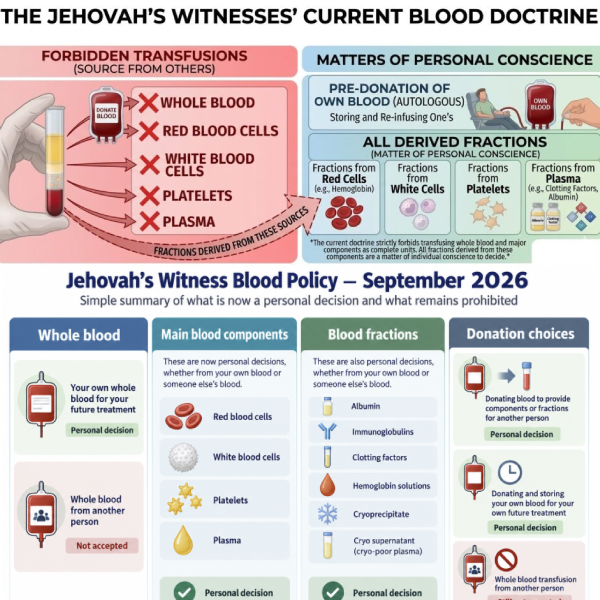
On September 18, 2026, the Governing Body announced that Jehovah’s Witnesses may now decide for themselves whether to receive another person’s red blood cells, white blood cells, plasma, or platelets. Members may also choose to donate blood specifically to provide components or fractions for someone else’s treatment. These decisions are now matters of individual conscience.
For a patient facing treatment, this may mean an option they previously believed they could not accept. For a bereaved family, it may mean looking at a photograph and asking whether their loved one might have had a different future. Both responses deserve room.
For those whose loved ones died after refusing blood under the previous teaching: we are deeply sorry for your loss, and for the pain this announcement may have reopened. You should not have to hide that pain to make room for someone else’s celebration.
This isn’t the first change to the Blood Doctrine in 2026. On March 20th, 2026, the Governing Body of the Jehovah’s Witnesses Organization publicly “clarified” that a member’s own blood may be removed, stored, and later returned as a matter of personal decision in medical care.
AvoidJW published two articles in March regarding the first recent change, “NEWS: Jehovah’s Witnesses change Blood Doctrine: What about the losses?“ and “The Blood Doctrine On Trial,” about Jehovah’s Witnesses’ blood doctrine changes in March.
If you don’t want to watch the JW broadcast on their site, you can download it here through AvoidJW. The announcement on blood starts around 3:40. JW Broadcasting, September 18th 2026
Yes, these are blood transfusions
The significance of the change should not be obscured by terminology. A transfusion of red cells, platelets, or plasma is a blood transfusion. The organization’s own updated medical information now explicitly describes donor-component transfusions as decisions for the individual Witness patient. The Governing Body didn’t outright say, “You can now accept a blood transfusion,” but this is what that means.
These are not merely tiny fractions or products unrelated to ordinary transfusion medicine. Red cells carry oxygen and can be transfused for serious anemia or blood loss. Platelets help prevent or control bleeding. Plasma supplies important clotting proteins. Certain white cells, called granulocytes, may be transfused for selected infections that do not respond to antibiotics. Different patients need different treatments; the components are not interchangeable.
The remaining restriction is specific: transfusions of another person’s whole blood remain prohibited, as do donations intended for that use. But members may now donate blood expressly to supply components or fractions. The prohibition on whole-blood transfusions should not be mistaken for a continuing ban on every form of blood transfusion.
September’s announcement also goes beyond the March 20, 2026 change concerning the collection, storage, and subsequent use of a patient’s own blood. The latest revision extends personal choice to primary components obtained from another person.
That is a substantial expansion of what the organization permits, not merely a change in vocabulary.
What is a personal choice today was presented as God’s law
The earlier position was explicit.
A Watchtower answer first published in June 2000 and reprinted on June 15, 2004, stated that accepting whole blood or any of its four primary components violated God’s law. Fractions derived from those components could be considered individually, but the components themselves were prohibited. The article declared: “God’s law on blood is not open to reform to fit shifting opinions.”
That same article already described doctors prescribing component transfusions. It even suggested that patients confirm with medical personnel that none of the prohibited products would be administered under any circumstances. These treatments were not unknown. Their religious classification is what has changed.
The new explanation says that Scripture does not specifically address products derived from blood and acknowledges limits on the Governing Body’s authority to impose requirements beyond what is written. It also invokes the importance of not exercising mastery over another person’s faith. Those are meaningful principles. They also leave a difficult question:
If individual conscience is the appropriate place for these decisions now, why was that freedom withheld before?
Religious organizations can reconsider their interpretations. But when an interpretation governs decisions about medical treatment, reconsideration carries responsibilities beyond announcing the replacement rule.
People who followed the previous instruction cannot return to the hospital room and start again.
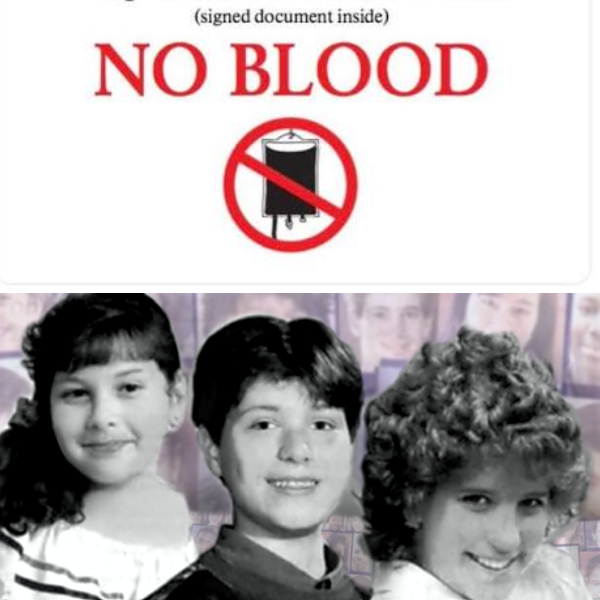
The historical record contains children’s names
The human stakes are not found only in critics’ accounts. They appear in Watchtower’s own publications.
The May 22, 1994, Awake! described Lenae Martinez, a 12-year-old with leukemia. According to the magazine, her doctors recommended packed red cells and platelets alongside chemotherapy. She refused blood products on religious grounds, with her parents’ support. The article reported that she died in her mother’s arms on September 22, 1993.
The magazine also said that doctors had discussed transfusions potentially extending her life by three to six months. That distinction matters: this was the publication’s account of possible additional time, not proof of a cure or an independently reviewed medical file.
But its relevance to the present change is unmistakable. Red cells and platelets, the treatments described in that account, are among the components now left to personal conscience.
Lenae’s story should not become a weapon against a grieving family. Nor should any child be remembered only as an example supporting a religious position. Before the article about her faith, there was a child whose life mattered. Additional time is not a small thing to the people who would have spent it together.
After extensive research with AvoidJW, we found more than 2,000 comments from Former and active Jehovah’s Witnesses who have lost a loved one due to the organization’s blood doctrine. And there are many, many more.
To everyone for whom this came too late
Advocates for Jehovah’s Witness Reform on Blood, or AJWRB, reports that it is already hearing from people struggling with the announcement, including surviving relatives experiencing renewed grief, anger, and questions about earlier medical decisions. Some may feel relieved. Some may feel betrayed. Some may not yet have words for what they feel.
No one should be required to produce the “right” response.
Perhaps you remember being beside the bed. Perhaps you were too young to understand the conversations taking place around you. Perhaps you supported a refusal because you sincerely believed it was necessary to protect someone you loved, not only in this life, but beyond it.
Perhaps the question troubling you now is not only: Could they have lived? It is also: What did we believe we were required to do?
To the person replaying an old conversation: you deserve support while you make sense of it. To the person who cannot bear to watch the update: you do not owe anyone an immediate reaction. To the person who welcomes the change and then feels guilty for welcoming it: hoping that another family may have more options does not diminish your love for the person you lost.
And to those who remain Jehovah’s Witnesses: Please consider the lives lost, the pain caused. This is a delicate situation, and it should not be taken lightly.
We are sorry your loved one is not here. We are sorry for the questions this announcement may have placed beside your grief. And we will not ask you to make your loss smaller because the policy has changed.
Your loved one was more than the circumstances of their death. They were a voice, a personality, a relationship, a whole life, not simply a case in a debate about blood. Whether you wish to tell their story or keep it close, they deserve to be remembered with dignity. A doctrine can be rewritten.
The people you love should never be written out.