
JEHOVAH’S
WITNESSES
JEHOVAH’S
WITNESSES
More than 12 years revealing secrets because there is no excuse for secrecy in God’s true religion – The Watchtower, June 1st 1997; Dan 2:47; Matt 10:26; Mark 4:22; Luke 12:2; Acts 4:19, 20.

Written and Published by: Miss Usato, March 30th, 2026
The Jehovah’s Witnesses’ new blood-policy clarification may not automatically create lawsuits, but it does raise new legal questions. This piece explores what the shift could mean for wrongful-death claims, informed consent, and the families still carrying the loss.
Clarification vs a Change
On March 20th, 2026, the Governing Body of the Jehovah’s Witnesses Organization publicly “clarified” that a member’s own blood may be removed, stored, and later returned as a matter of personal decision in medical care.
On social media, from JW and Ex-JW Reddit to Facebook, Instagram, and beyond – people have been arguing over whether the Governing Body’s latest blood update is really just a “clarification” or an actual change to doctrine. Jehovah’s Witnesses are also downplaying the update, saying, “It was always a personal choice.” Let’s get this straight: calling it a clarification does not erase the fact that the practical outcome is different. Governing Body member Gerrit Losch may point back to the 2000 Watchtower article, which said that “other procedures or tests involving an individual’s own blood are not so clearly in conflict with God’s stated principles,” but that same article also plainly said, “we do not donate blood, nor do we store for transfusion our blood that should be ‘poured out.’” And that is exactly where the problem is.
JW.org’s current autotransfusion guidance still says Jehovah’s Witnesses “do not accept preoperative autologous blood donation,” while listing other blood-management procedures as personal decisions. So if the new update now says a Christian may decide whether his own blood can be removed, stored, and later returned, that is not just a clarification in any meaningful sense. It is a change in application, and for many, a change in doctrine dressed up in softer language.
At the same time, JW.org’s older medical materials had long said that preoperative autologous blood deposit for later reinfusion was prohibited, and older Watchtower guidance said blood that left the body should be “poured out,” not stored for transfusion. That means a once-forbidden medical option has now been moved into the conscience category.
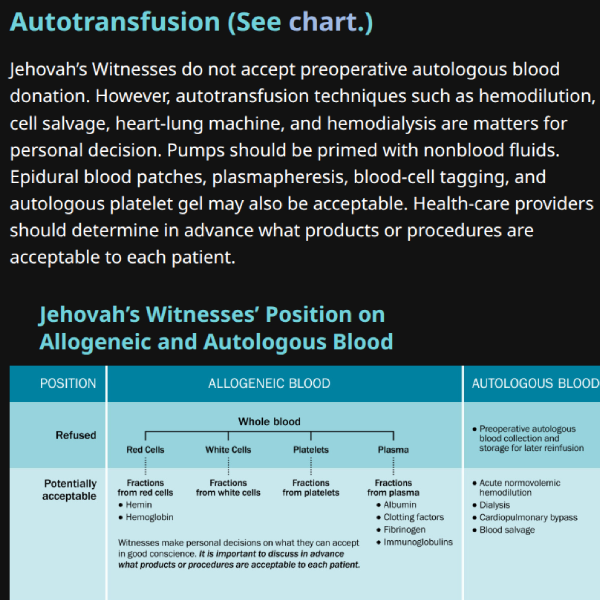
This is why so many people discussing this online are rejecting the word clarification, as the Governing Body member states in the Update. The 2000 article did say that some procedures involving a person’s own blood were not “so clearly in conflict” and that individual Christians had to decide how their own blood would be handled during a procedure. But in that very same article, Watchtower drew a bright line against collecting, storing, and later transfusing one’s own blood. We cannot honestly pretend that stored self-donated blood was already sitting comfortably inside that category. The article explicitly carved it out as forbidden.
That distinction matters because a reinfusion is still a transfusion. The mechanics have not changed. Blood is removed, stored, and later returned to the bloodstream. For years, Witnesses were told that this violated God’s law. If that is now being left to personal conscience, then the substance has shifted even if the Governing Body prefers to market the move as a clarification. Same blood. Same procedure. Different verdict.
Eyes on the Evidence

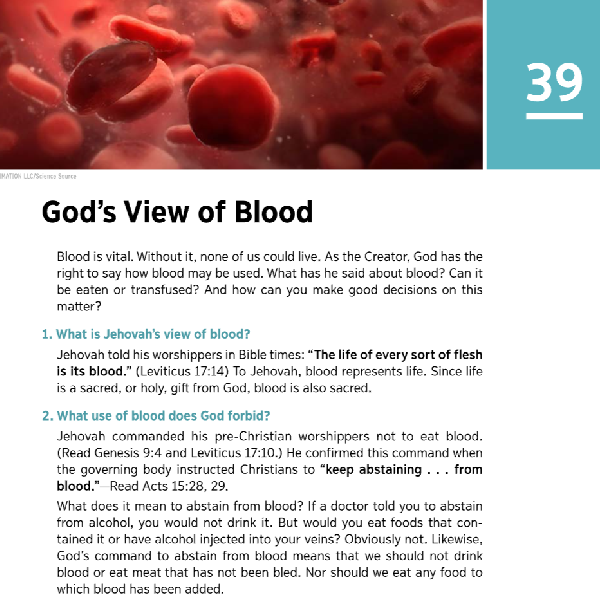

Jehovah’s Witnesses first formally began prohibiting blood transfusions in 1945. The link between the Bible’s command to “abstain from blood” and transfusions appears in The Watchtower, July 1, 1945. Later, in 1961, accepting a transfusion was made a disfellowshipping offense for an unrepentant Witness. Above are only some Jehovah’s Witness references regarding the prohibition of blood, including auto-transfusion. The official Watchtower Online Library topic index for “Blood Transfusions” spans hundreds of linked references across English publications from 1950 to 2026. Based on the visible linked citations on their official index page, it is clearly well over 100 mentions.
In the publication How Can Blood Save Your Life? It reads “Witnesses believe that blood removed from the body should be disposed of, so they do not accept autotransfusion of predeposited blood. Techniques for intraoperative collection or hemodilution that involve blood storage are objectionable to them.”
What does this mean for families who lost loved ones under the old rule?



Above (Click photo to access article) are articles of instances where Jehovah’s Witnesses lost their lives due to the Blood Doctrine. However, the research is unclear on whether every single one of them could have been saved by pre-donating blood; it’s still heartbreaking that it exists at all. For families who lost someone under the prohibition of pre-donating their blood, the emotional reaction is obvious: If this can change now, what does that mean for the people who died before it changed? The legal answer is harder and much less satisfying.
The policy on stored autologous blood does not, by itself, open the courthouse doors. Families would still need a recognized legal claim, such as wrongful death, negligence, fraud, malpractice, coercion, or interference with informed consent, and they would still have to prove causation, overcome filing deadlines, and fit their case into the law of the jurisdiction where the death occurred. Legal liability does not spring into existence just because a religious rule later softens.
But the update could change how lawyers read the facts.
If a patient refused treatment because they were told a particular procedure was forbidden by God, and the same procedure is later recast as a matter of personal conscience, that can raise new legal questions. Lawyers may ask whether members were misled, whether material information was withheld, whether internal teachings were framed more absolutely than the published record justified, or whether pressure from elders or organizational culture undermined meaningful informed consent. None of that guarantees a winning case. It does mean that old facts may look different under a brighter light.
The hardest lawsuits would still be the ones involving a competent adult who clearly refused blood in writing, such as the No Blood card Jehovah’s Witnesses carry around in their wallets. Courts have often treated an adult patient’s informed refusal of blood on religious grounds as legally significant, even when the consequence was death. That is why claims tied to minors, disputed capacity, misleading disclosures, or coercion are more likely to attract serious scrutiny than cases where an adult’s refusal was clear and documented.
It will never get them back, and we know how painful that realization is, but we suggest doing research, contacting a lawyer, gathering evidence, and seeing if anything can be done. Overall, we are deeply Sorry for your loss.
We will never know how many
A 2025 review in Archives of Disease in Childhood says it identified 19 English court judgments involving refusal of blood transfusion by or on behalf of children in Jehovah’s Witness families. This spans from the U.S., Canada, Scotland, and Japan, and more countries, showing this issue is a global harmful practice. Yet, it is highly unlikely for a Jehovah’s Witness Family to speak to the media if such a tragedy were to happen. You have to take into account the families who didn’t want the media or general public to know. The ones who passed themselves. The doctors and nurses who were not interviewed were involved, and simply, not every single death on this topic has been accounted for under “refusal of blood transfusion.” Doctors would not label the passing of someone under those terms, either.
Upon research, I documented a minimum of at least 29 reported judicial decisions/cases touching Jehovah’s Witness blood-transfusion disputes across multiple jurisdictions. That is almost certainly not the full global total. It is simply the floor I could verify from accessible, citable sources.
Upon looking up this topic just once on social media through Facebook, TikTok, and Instagram, there have been over 360 Comments regarding a former or active Jehovah’s Witness losing a loved one due to the Blood Doctrine. The number is far greater.
This is not a harmless clarification. It is a doctrinal shift with a human toll. Lives have been lost under rules that were enforced as absolute, only to be softened later with new wording. If someone cannot recognize the difference between “abstain from blood” and “this is now a personal decision,” then they are ignoring the obvious, and that becomes especially chilling when those decisions involve someone’s child, spouse, parent, or even their own life. The Governing Body teaches that these rules reflect God’s will, yet history shows they can be changed almost overnight. That is not divine consistency. That is institutional power dressed up as certainty.