
JEHOVAH’S
WITNESSES
JEHOVAH’S
WITNESSES
More than 12 years revealing secrets because there is no excuse for secrecy in God’s true religion – The Watchtower, June 1st 1997; Dan 2:47; Matt 10:26; Mark 4:22; Luke 12:2; Acts 4:19, 20.
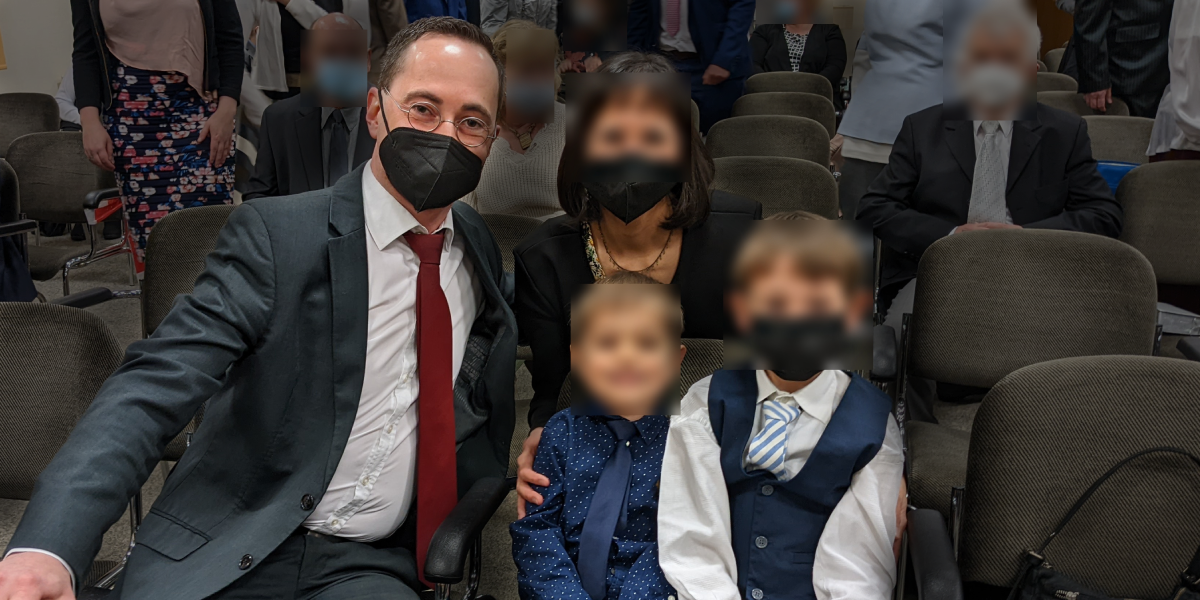
David and his family
Written and published by: Miss Usato, October 7th 2026, Updated: October 18th, 2026
AvoidJW Interview: In 2024, a father asked the Jehovah’s Witnesses Branch in Germany to explain why conscience stopped at the hospital door. Two years later, the Governing Body changed the rule he had challenged.
What happens when obedience to the Governing Body conflicts with the instinct to keep your family alive?
A Father questions the Central Europe Branch of Jehovah’s WItnesses
Growing up as a Jehovah’s Witness, David had spent much of his life trying to be the kind of Witness who didn’t look for loopholes. In fact, he had taken the opposite approach: when his religion allowed certain blood fractions as a matter of conscience, he chose the stricter option and rejected those too. In his mind, greater restriction meant greater spiritual safety. Then, he had children.
David began diving into deep, extensive research on the biblical basis for the blood doctrine.
AvoidJW: What was your mindset toward the blood doctrine before you began researching it?
David: “The motto ‘better safe than sorry’ meant for me: better to strictly follow the rules and accept death than to trust an intuition that might turn out to be wrong, and possibly lose God’s approval.”
Once David became a father, the stakes stopped being abstract.
David: “There were now two vulnerable little human beings who didn’t care at all about theology and two-thousand-year-old texts. They needed protection, care, and their father. I decided not to rest until I truly understood the background of the Christian prohibition on blood. I could no longer rely on the interpretations of men living somewhere in America who regularly update their understanding of the Bible, sometimes with significant consequences for believers’ lives. I felt accountable to my conscience, not to other people. After all, no one but me would bear the responsibility for the consequences for my family.”
He decided to write to the branch in Germany and appealed to world headquarters.
You can find David’s letter here. In his letter, he asked whether a life-and-death medical decision could truly be called a matter of faith if a Witness’s conscience pointed in one direction while the Governing Body required another.
In January 2024, the Central Europe branch sent him a four-page response defending the existing understanding. Quotes from the Branch’s letters are found below.

Twenty months later, on September 18, 2026, the Governing Body announced that Jehovah’s Witnesses may decide for themselves whether to receive another person’s red blood cells, white blood cells, plasma, or platelets. Witnesses may also choose to donate blood for the stated purpose of providing components or fractions to someone else.
Why did their stance on blood transfusions change?
The Governing Body says Scripture does not comment on the various products derived from blood, and therefore it is not authorized to “go beyond the things that are written.” It additionally cites the principle that religious leaders are not “masters over” another Christian’s faith. You can find this on their site in the September 2026 JW Broadcasting under ‘What’s New.’
Those are remarkably close to the very principles David had placed before the organization two years earlier.
No evidence shows that David’s letters caused the change; in fact, I’m sure the branch received many letters similar to David’s, but his correspondence creates something unusually valuable: A dated record of what one believer asked before the doctrine changed, and what the organization told him before it decided that conscience should govern the very medical choices he was questioning.
David was not trying to dismantle the religion when he began questioning blood. Quite the opposite.
AvoidJW: What changed when you became a father?
David: “I felt accountable to my conscience, not to other people.” He told AvoidJW that no religious leader would ultimately bear the consequences for his family if he died. His children would. That realization transformed his question. It was no longer: Am I obedient enough? It became: Would a loving God actually require my children to lose their father because I accepted treatment intended to preserve my life?
This exposes something easily missed when the blood doctrine is discussed only in theological terms. For a committed Witness, this was not simply a debate over medicine. It involved eternal life. David says he had learned to distrust his own reasoning when it appeared to conflict with organizational direction. So when he completed his medical directive, he chose the most restrictive options available. Then his children entered the equation.
The Branch’s response: Blood was sacred, the prohibition was rigorous
The January 18, 2024 letter David received from the Jehovah’s Witnesses Central Europe Branch Office in Selters, Germany, did not treat the doctrine as an uncertain medical gray area. The branch acknowledged that many people interpret the biblical prohibition against blood as dietary. It rejected that understanding.
Its letter argued that Genesis established blood as a symbol of life, that refraining from using blood recognized God’s authority over life, and that the prohibition represented a moral and ethical principle rather than merely a food restriction.
The response went further.
On page two, it stated: “This decree is therefore an early Christian ‘dogma’ and not a newly formulated one from a modern religious community.” By page four, the Branch’s conclusion was unequivocal: “The prohibition against blood is thus entirely consistent and rigorous, from its first mentions in Genesis through the Mosaic Law to the earliest Christian writings.” These statements framed the organization’s interpretation as an enduring obligation, leaving little room for the alternative reasoning David had raised.
Perhaps the most revealing statement appeared near the letter’s conclusion: “If one perceives this rationale behind the decree as such, there is no need to seek various attempts at explanation in order to relativize the clear biblical passages.” For David, however, the questions concerned decisions his family might face in a medical emergency. The correspondence captures that tension: a father asking the organization to reconsider its reasoning, and a Branch responding that its interpretation was already clear. The language in this letter matters today because the September 2026 explanation differs substantially.
2024 versus 2026: The contradiction in plain sight
Until September 2026, Jehovah’s Witnesses rejected transfusions involving red cells, white cells, platelets, and plasma. JW.org itself described that position plainly in earlier publications. Today, JW.org tells clinicians: Witness patients now personally decide whether to accept transfusions of donor red cells, white cells, plasma, or platelets. And the Governing Body explains why: “Because Scripture does not comment on the medical products derived from blood, it says it cannot go “beyond the things that are written.”
Put the two positions beside one another:
| January 2024 branch response | September 2026 Governing Body position |
|---|---|
| The prohibition is described as “entirely consistent and rigorous.” | Four primary blood components are now a personal conscience decision. |
| Blood is described as reserved exclusively for God’s disposal. | A Witness can accept donor red cells, white cells, plasma or platelets. |
| The branch argues against attempts to “relativize” the blood prohibition. | The Governing Body says it cannot go beyond what Scripture actually states. |
| Historical medical uses of blood are cited in defense of abstention. | Blood-component transfusions are now explicitly permitted as a personal choice. |
| David asks for room for conscience. | Conscience is now the official standard for those components. |
Regarding the four primary blood components, the logic has undeniably shifted. The rule once told the believer no. It now tells the believer to decide for yourself. And the theological justification for that new freedom invokes the exact territory David had been asking the organization to examine: conscience, scriptural limits, and the danger of religious leaders going beyond what is written.
David had already asked: What if the principles conflict?

The branch’s response did not resolve David’s problem. So on April 10, 2024, he wrote again, and more directly.
He explained that he understood the instruction to obey those leading. But he also understood Christianity to require mercy, humane treatment during distress, personal faith, and resistance to allowing human beings to become masters over someone else’s conscience. He believed the blood doctrine forced those principles into collision.
AvoidJW: How did you describe that conflict to the branch?
David wrote: “If I follow the one principle, I sin against my conscience and my family, and thus against God.. But if I follow the other, I sin against the Governing Body and must expect disfellowshipping.”
He was not announcing that he wanted to leave Jehovah’s Witnesses. In fact, his letter said the opposite precisely: “Far be it from me to distance myself from the association of Jehovah’s Witnesses by means of a conscientious decision.” This was not an “apostate” challenging doctrine from outside. This was a believer asking his own religious leadership for enough clarity to make a medical decision without violating either his faith or his responsibility as a parent.
David’s Response to the Branch’s letter – March 7, 2024
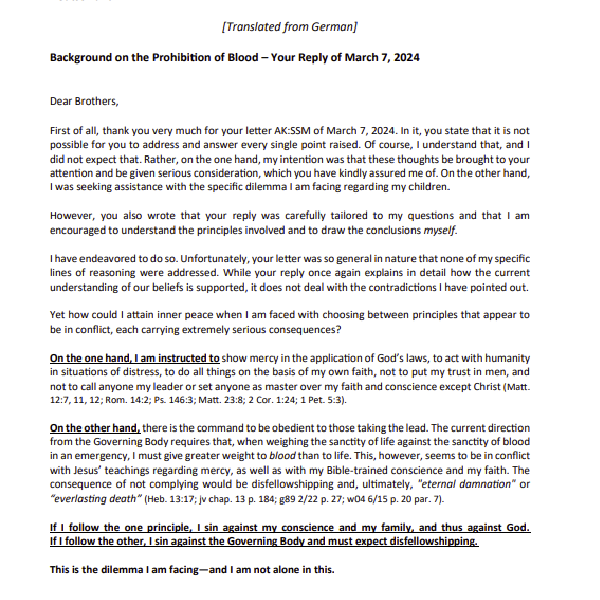
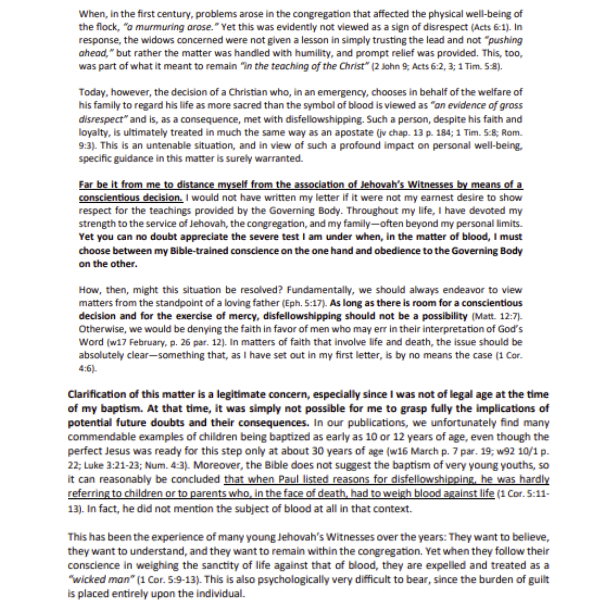
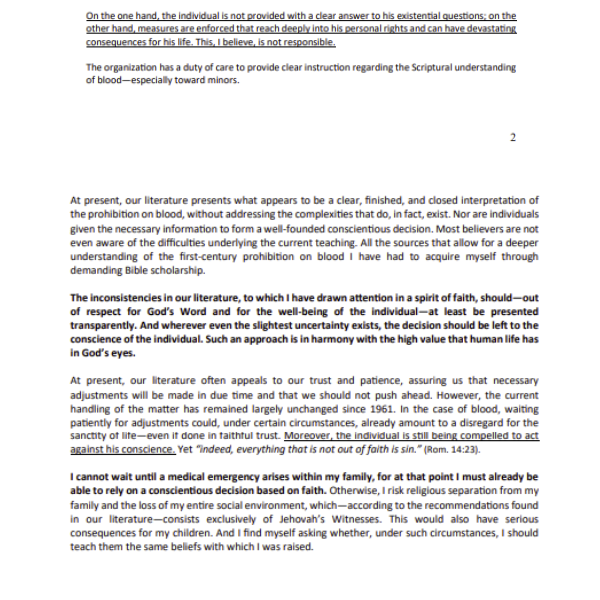
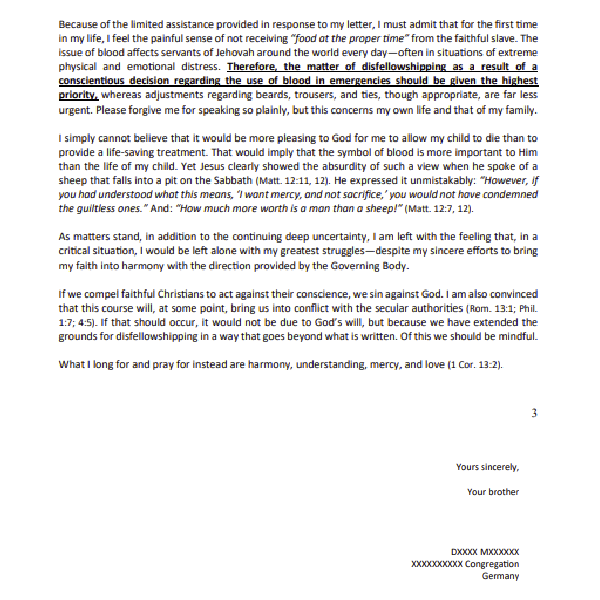
David Asked for Conscience Before It Became Policy
In April 2024, David told the branch that where genuine uncertainty existed, medical decisions should be left to the individual conscience. By 2026, when this change happened, David’s letter had become a timestamp. He was asking for conscience before conscience became policy.
“I Cannot Wait Until a Medical Emergency Arises”
David also warned that patients could not simply wait for doctrine to change: “I cannot wait until a medical emergency arises within my family…” He wrote that “waiting patiently for adjustments” could itself disregard the sanctity of life, and that warning now carries considerably more weight. A policy about beards or ties can change years later without irreversible consequences. A medical decision made during catastrophic bleeding cannot.
Questioning the Rule Had Consequences
David: “I was shunned within my family and by some in the congregation simply because I had written this letter to Bethel.”
Today, the Governing Body says congregations should not involve themselves in decisions involving the newly permitted components, and Witnesses should not judge one another over them. The contrast: a question that could attract suspicion in 2024 concerns a decision officially protected as personal conscience in 2026.
The Same Scriptures – A Different Conclusion
David cited 2 Corinthians 1:24, arguing that no human should become “master” over another Christian’s faith. He also invoked 1 Corinthians 4:6 – not going beyond what is written. The Governing Body now uses those same principles to explain why the four primary blood components should be left to personal conscience.
The striking parallel is that the organization now uses the principles David invoked while asking why that freedom was being denied.
What Changed Was the Interpretation
This does not prove that every patient who previously refused a transfusion would have survived. But it does establish an important difference. Before September 2026, Witnesses were taught that accepting these components violated God’s command. Now they are told: Decide for yourself. The religious interpretation changed.
Near the end of his letter, David wrote: “I simply cannot believe that it would be more pleasing to God for me to allow my child to die than to provide a life-saving treatment.”
In 2024, the branch defended the blood prohibition as consistent and rigorous. In 2026, the Governing Body decided that the four primary components belong to individual conscience. David had asked for exactly that freedom more than two years earlier.
David: ” Back in March, I realized that the leadership of Jehovah’s Witnesses still has not understood even the most basic background of the blood prohibition from Acts. Essentially, the Governing Body is a group of religious laymen, yet with greater authority than the Pope in Rome. None of them can read the ancient biblical languages or has a university degree in theology.”


Aiding Transparency to Watchtowers teachings. If you have additional information about this topic or would like to reach the author- Please email MissUsato@proton.me