
JEHOVAH’S
WITNESSES
JEHOVAH’S
WITNESSES
More than 12 years revealing secrets because there is no excuse for secrecy in God’s true religion – The Watchtower, June 1st 1997; Dan 2:47; Matt 10:26; Mark 4:22; Luke 12:2; Acts 4:19, 20.
Written, researched, and published by: Miss Usato, June 30th, 2026
For most Jehovah’s Witnesses today, the Great Pyramid of Giza has no place in Bible prophecy. Modern Watch Tower publications reject pyramidology, yet few realize the organization once promoted those very beliefs, publishing them in its literature, teaching them at conventions, and even memorializing them in granite.
Today, JW.org contains no photographs of Charles Taze Russell’s pyramid monument, no explanation of why it was built, no mention of the time capsule sealed inside it, and no discussion of its removal after being vandalized. Why?
Using official Watch Tower publications preserved in the AvoidJW archives, this article uncovers misconceptions, a forgotten doctrine, a lost monument, and a remarkable chapter of the organization’s history that has largely faded from view.
Monuments are built to preserve memory – Sometimes they become evidence instead
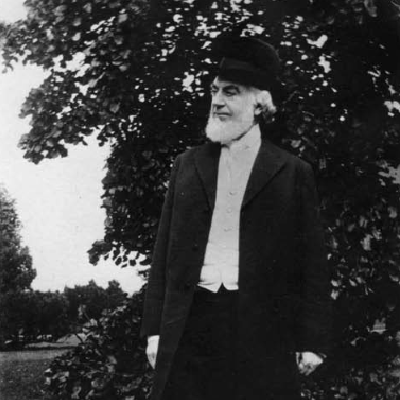
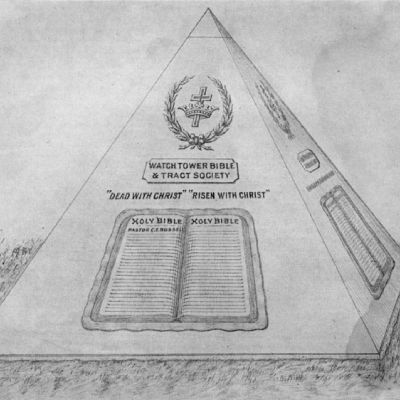
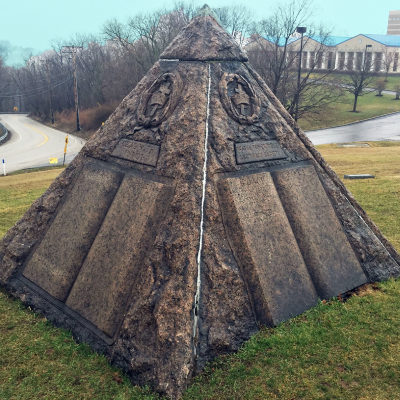
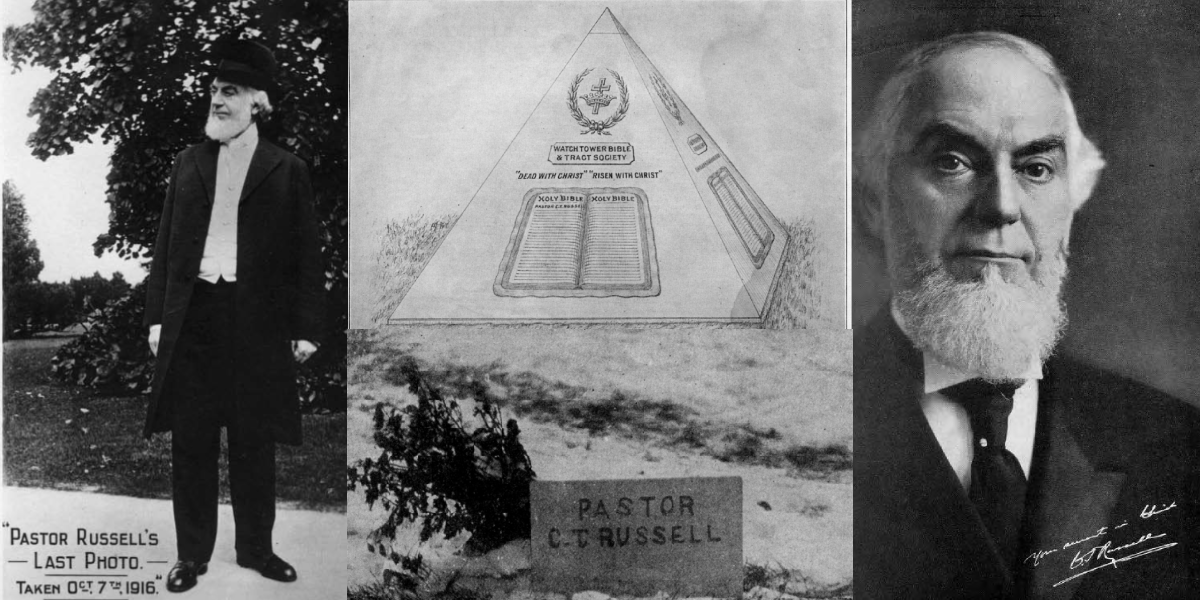
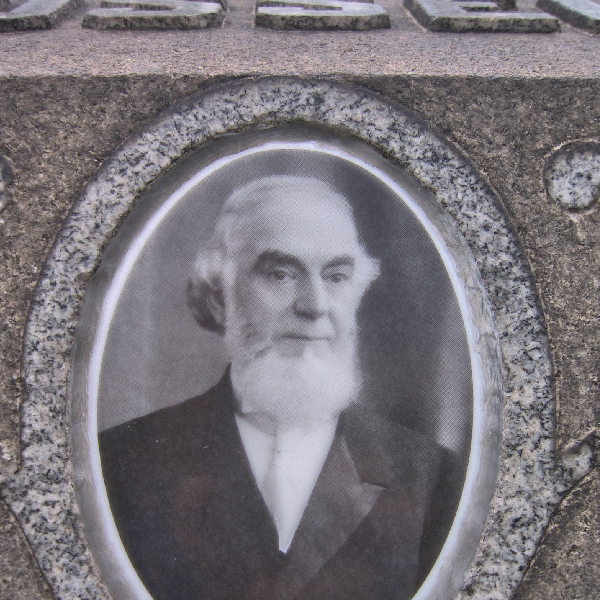
For decades, a massive pyramid stood beside Charles Taze Russell’s grave in Pittsburgh, Pennsylvania. It was not an eccentric memorial erected by an admirer. It was conceived, approved, and celebrated by the Society itself, and to put it bluntly, the Society idolized and glorified the Pyramid. Official convention reports described its construction in detail, photographed it proudly, and presented it as a fitting symbol of the Watchtower movement’s faith.
More than a century later, in 2021, the monument is gone. The story of why it was built, and why it quietly disappeared, reveals a chapter of Watch Tower history that many Jehovah’s Witnesses have never been told.
More Than a Pink Grave Marker
A common misconception is that the pyramid was simply Charles Taze Russell’s headstone. It was not.
The Bible Students envisioned the Watch Tower burial grounds as a memorial cemetery for the Society’s workers. Russell’s grave occupied one section, but the pyramid was designed as the centerpiece of the entire burial plot.
An 1919 official convention report explains: “The Watch Tower Society burial lots in Rosemont United Cemeteries… contain ample grave space for all the members of the Bethel family, and the Pilgrims and their wives… In the exact center of the Bethel lot will be erected… the Pyramid Shape Monument.”
The report continues: “The Monument as designed by Brother Bohnet, and accepted by Brother Russell as the most fitting emblem for an enduring monument on the Society’s burial space.”
This shows that the monument was neither an afterthought nor added years later by devoted followers.
It was designed, approved, and accepted by Charles Taze Russell himself as the Society’s enduring memorial. Russell even went as far as picking the type of Granite tint, his favorite color, pink. The convention report specifically identifies: “These monster blocks of pink (Brother Russell’s favorite tint) granite…”
Over the decades, exposure to the elements gradually dulled its color until many observers assumed it was plain gray stone or even concrete.
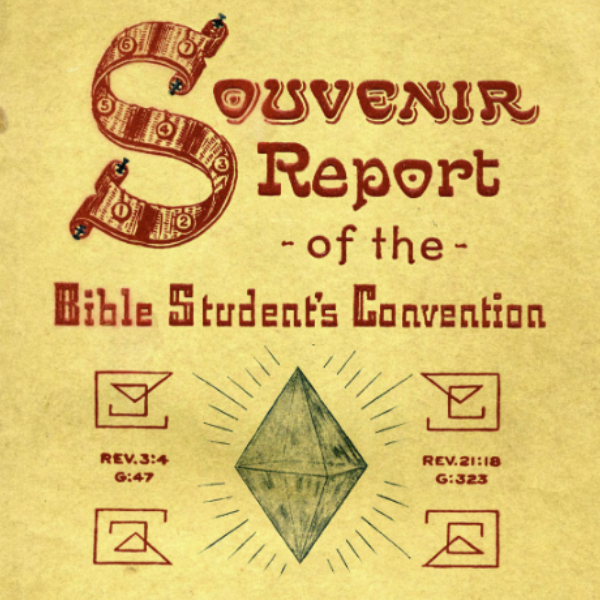
Why A Pyramid?
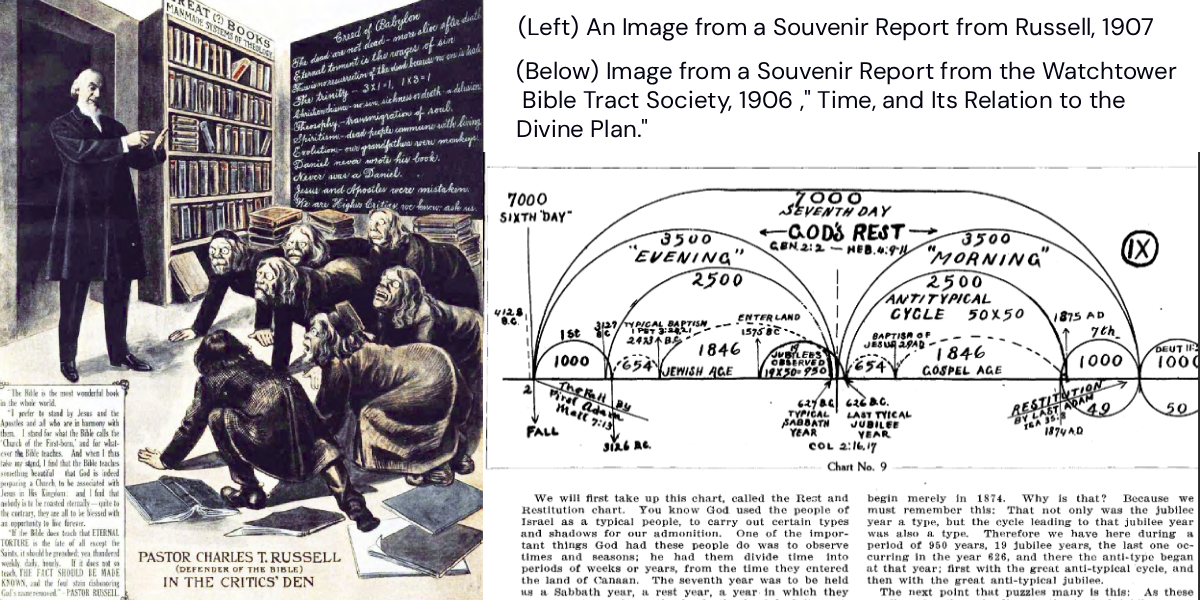
Link to photo: 1913 In the Critics Den.
To understand the monument, one must understand Russell’s theology. Russell believed the Great Pyramid of Giza was far more than an ancient Egyptian structure.
He referred to it as “God’s Stone Witness” and “The Bible in Stone.” There are dozens of references and well over 20 distinct illustrations or diagrams of the Great Pyramid and its interior across Russell’s publications.
In his view, the pyramid’s measurements confirmed biblical chronology, corroborated prophetic dates, and stood as an independent witness to God’s unfolding plan for humanity. He did not regard the pyramid as an object of worship. He regarded it as evidence. A silent testimony carved in stone. The granite monument erected beside his grave symbolized those convictions.
Russell knew that he was dying
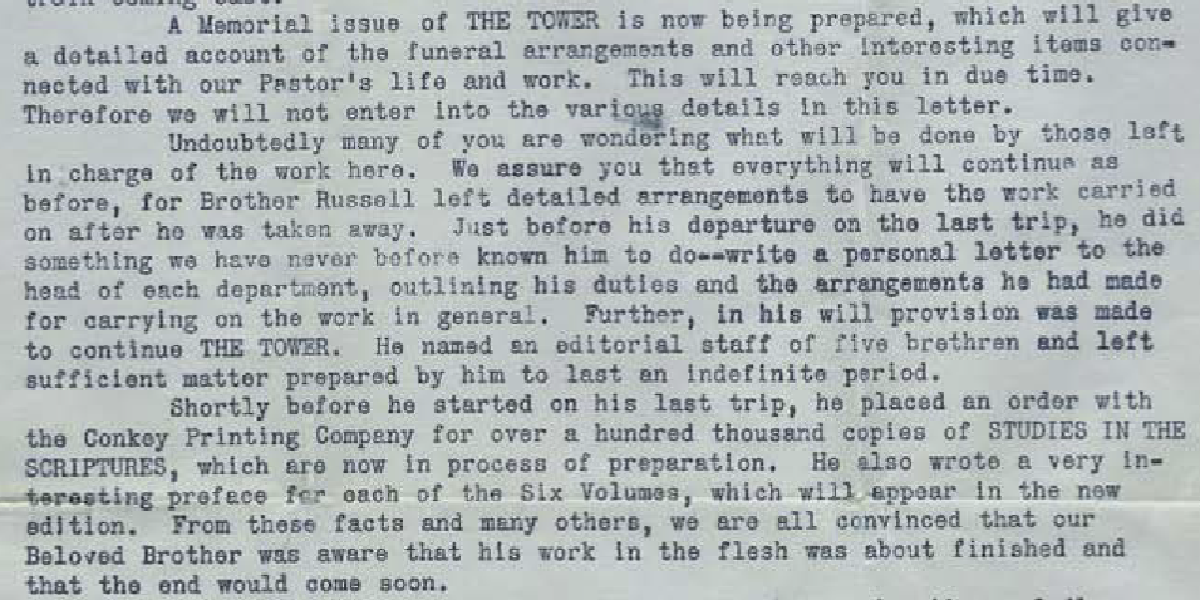
Months before his death, Charles Taze Russell appeared to recognize that his life’s work was drawing to a close. After suffering a serious illness following the Newport Convention in July 1916, he spent hours outlining plans for the future of the Watch Tower Society, organized an editorial committee, completed new prefaces for all six volumes of Studies in the Scriptures, and, according to his associates, did something they had “never before known him to do”: he personally wrote letters to the head of each Bethel department detailing their responsibilities after his departure. During his final speaking tour, when asked about the proposed Seventh Volume, Russell quietly replied, “Someone else can write that.” Too weak to keep his scheduled appointment in San Diego, he delivered his final discourse, “The World on Fire,” while seated before boarding an eastbound train.
On October 31, 1916, a Tuesday at 2:30 P.M., he died in the train’s private drawing room. Two weeks later, in a November letter, the Watch Tower Society wrote to its collaborators that, looking back on these final preparations, they had become convinced Russell “was aware that his work in the flesh was about finished and that the end would come soon.” It was fitting, then, that the man who had spent decades proclaiming the Great Pyramid as God’s “Stone Witness” chose to be buried in the Society’s own cemetery, where a granite pyramid, personally approved by Russell as “the most fitting emblem for an enduring monument”, would stand as the enduring symbol of the prophetic system he believed God had revealed.
A Monument Filled With Meaning
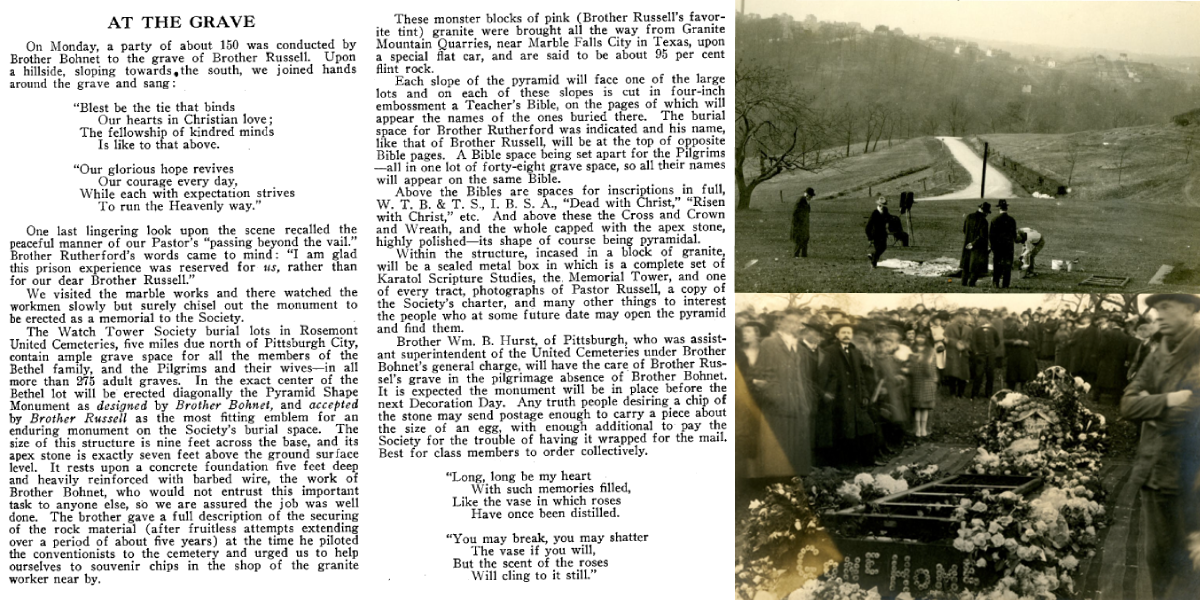
The Society’s own description (back then, at least) shows that every element of the monument was intentional.
It records that each face of the pyramid would overlook surrounding burial plots and contain engraved Teacher’s Bibles listing the names of those buried there. It further states that inscriptions would include “Dead with Christ” and “Risen with Christ.” Alongside the familiar Cross and Crown, the monument is completed by its apex stone. The image of the cross and ground was in every publication of Russell’s in the late 1800’s to the early 1900s, until the symbol was phased out with Rutherford.
These were not random artistic decisions. Together, they reflected many of the defining themes of early Bible Student theology: sacrifice, resurrection, prophetic fulfillment, and the completion of God’s purpose in Christ. On the day of his funeral, 150 people attended and looked down upon Russell’s open grave. The pyramid and its grave were littered with flowers, and they sang the song quoted in the article above, “At the Grave.”
A Time Capsule for Future Generations
Perhaps the most remarkable and least known feature of the monument lay inside it.
According to the Society’s own account:
“Within the structure… is a sealed metal box in which is a complete set of Karatol Scripture Studies, the Memorial Tower, and one of every tract, photographs of Pastor Russell, a copy of the Society’s charter, and many other things to interest the people who at some future date may open the pyramid and find them.”
This transforms our understanding of the monument.
It was not merely a memorial. They made it into a time capsule.
Its builders expected that future generations would one day open the pyramid and examine the beliefs upon which the movement had been built. This means that when it was destroyed in 2021, the society must have collected what lay inside.
Far from hiding the monument, the Watch Tower Society celebrated it, at least for a little while.
The 1919 Pittsburgh Bible Students Convention Souvenir Report, published after Russell’s death and during the very year Jehovah’s Witnesses now associate with Christ’s inspection of the organization, included a photograph of Russell’s grave and the pyramid monument as part of the movement’s heritage.
The changes that affect the Organization to this day
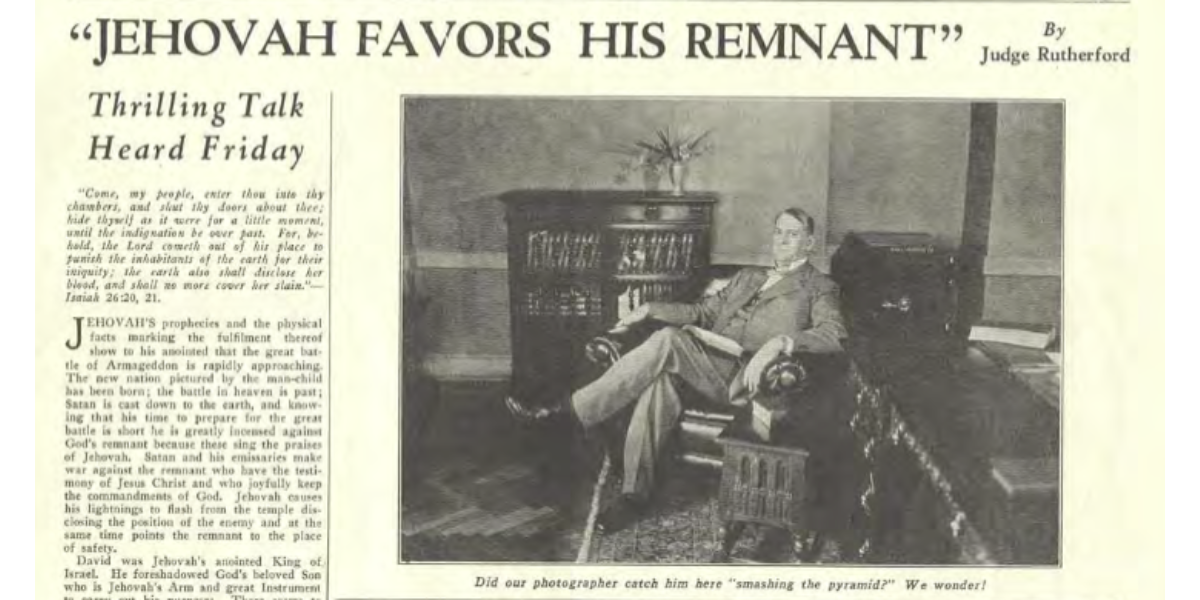
Following Charles Taze Russell’s death in 1916, Joseph F. Rutherford gradually transformed the Bible Student movement during the 1920s and 1930s. In doing so, he abandoned many of the teachings, symbols, and organizational principles that had defined Russell’s ministry. Ironically, many of these changes ran directly contrary to Russell’s own written wishes.
Russell’s Last Will and Testament reveals that he envisioned a decentralized editorial structure rather than leadership concentrated in a single individual. While he listed J. F. Rutherford among several men who might one day be considered to fill a vacancy on an editorial committee, Rutherford was not designated as Russell’s successor or chief editor. Instead, Russell proposed that The Watch Tower be governed by an Editorial Committee of five brethren, requiring at least three members to approve every article before publication. If disagreement arose, he instructed that publication be delayed for three months to allow time for prayerful discussion and unity. He also requested that articles remain anonymous, ensuring that the focus stayed on the message rather than the messenger.
Russell’s reasoning was explicit. He wrote: “…that the Lord may more particularly be recognized as the Head of the church and the Fountain of truth.”
He went even further, requesting: “…my name shall not be attached nor any indication whatever given respecting the authorship.”
These provisions suggest that Russell hoped to prevent the rise of a personality-centered organization and to safeguard against the concentration of editorial authority in one man.
Yet there is a striking historical irony. During Russell’s lifetime, and especially after his death, official convention reports repeatedly referred to him as “Our Dear Pastor,” prominently featured his photograph, and devoted entire sections to preserving his sermons. His image and teachings remained central to the movement, despite his own request that his name not overshadow the message.
As Rutherford consolidated leadership, the organization steadily moved away from Russell’s prophetic framework. Beginning in 1928, The Watch Tower published a series of articles rejecting pyramidology. In the November 15 and December 1, 1928, issues, Rutherford argued that the Great Pyramid was not God’s “Stone Witness” but was instead associated with false religion and satanic deception. The very monument that Russell had regarded as a divine confirmation of Bible prophecy was now publicly denounced.
The changes did not stop there. Over the following years, Rutherford systematically abandoned many of the beliefs and symbols that had once defined the Bible Student movement, including:
The doctrine disappeared. The symbols disappeared. The movement itself adopted a new identity.
For decades, however, one reminder remained.
The granite pyramid at Russell’s grave stood in the Watch Tower burial grounds long after the theology it represented had been rejected. In the end, the monument outlived the doctrine it was built to commemorate.
The Disappearance of the Pyramid, and why it still matters
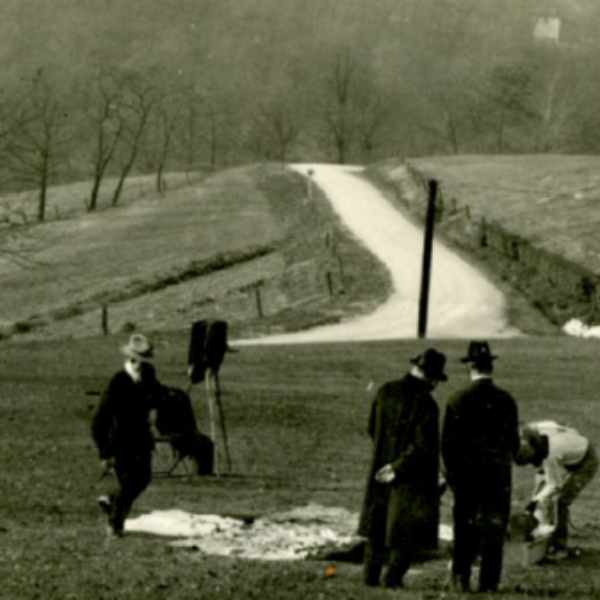
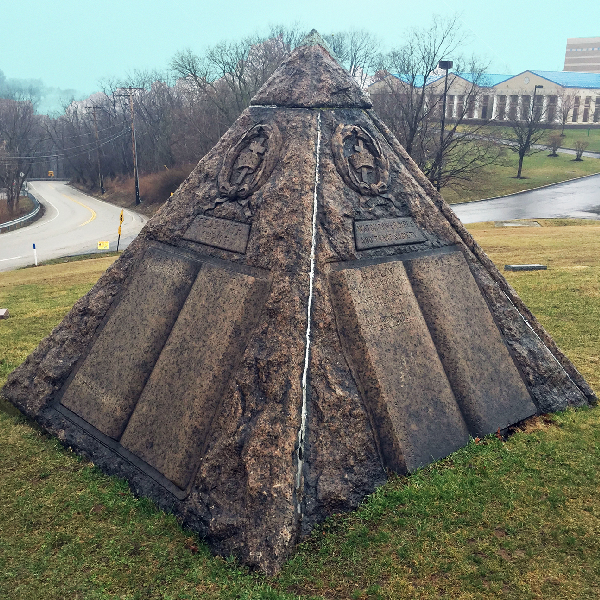
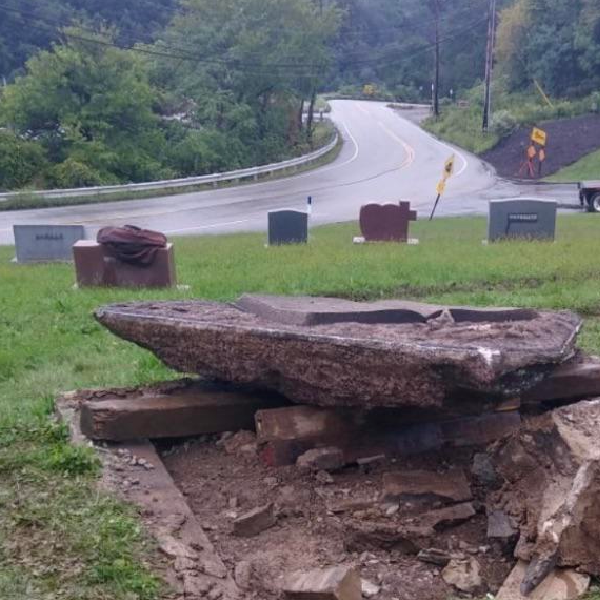
For more than a century, the pyramid stood as a silent reminder of the beliefs that shaped the early Bible Student movement. In 2021, after being vandalized, the monument was dismantled rather than restored. What became of it remains uncertain. AvoidJW’s writers have said -but not confirmed, that the remaining granite sections were moved to storage at the Jehovah’s Witnesses Assembly Hall in Coraopolis, Pennsylvania, but the organization has never publicly confirmed those reports or explained what ultimately became of one of the most recognizable monuments in its early history.
Researchers now understand the Great Pyramid as an extraordinary engineering achievement constructed during Egypt’s Fourth Dynasty, around 2580–2560 BCE, as part of Pharaoh Khufu’s royal funerary complex. Its mathematical precision continues to fascinate historians and engineers. But there is no accepted archaeological evidence that its passages or dimensions encode biblical chronology or predict future events.
In that respect, modern scholarship and the modern Watch Tower Society now agree. Neither accepts Russell’s prophetic conclusions. The issue is not whether Russell was correct. History often preserves sincere ideas that later generations abandon. The real question is different.
Why are so few Jehovah’s Witnesses aware that this was once part of their own religious heritage?
So many lifelong members never learn that Russell’s grave was marked by a pyramid. Official Watch Tower convention reports proudly published photographs of it around the time of his death, and these publications were circulated during the very period the organization now identifies as the time of Christ’s inspection. Yet now, you will not find one article regarding it on the Watchtower’s site.
The story of the pyramid is a silent reminder that the Watchtower and Bible Tract Society once believed, published, celebrated, and memorialized ideas that many of its members today have never been told existed. Some beliefs that have swayed, manipulated, and taken lives due to false prophecy.
Stone has a remarkable memory. It preserves what time cannot erase and what institutions sometimes leave behind. For an organization that claims to be God’s one true religion, history deserves to be confronted with the same honesty it asks of everyone else.