
JEHOVAH’S
WITNESSES
JEHOVAH’S
WITNESSES
More than 12 years revealing secrets because there is no excuse for secrecy in God’s true religion – The Watchtower, June 1st 1997; Dan 2:47; Matt 10:26; Mark 4:22; Luke 12:2; Acts 4:19, 20.
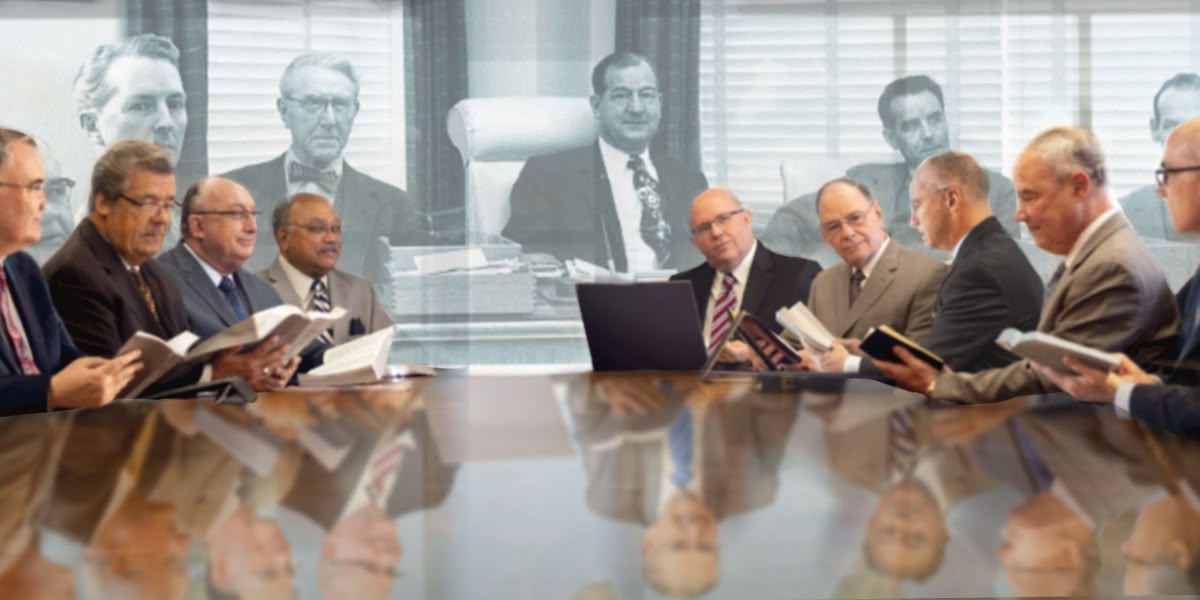
Decades of Governing Body members. Photo edited and designed by: Miss Usato
Article written and published by: Miss Usato, September 18th, 2026
For decades, Jehovah’s Witnesses have been warned about the dangerous, diseased, poisonous, wolf-like creature known as the apostate. But Watchtower’s own definition of apostasy raises an inconvenient question: What do you call an organization that repeatedly abandons teachings it once required millions of people to accept?
Beware the Apostate
There is a creature lurking outside the Kingdom Hall. According to Watchtower literature, it can disguise itself as a sheep. It may behave like a smuggler. It carries counterfeit material. Its words spread like gangrene. Its ideas are poison. It may even be mentally diseased and eager to infect you.
Terrifying stuff. You might reasonably expect horns. Instead, Watchtower says this creature may simply be someone who once sat beside you at the meeting. An apostate.
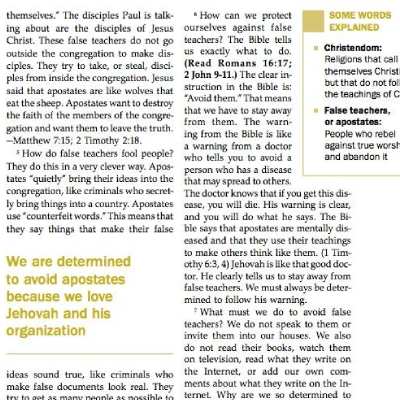
For decades, Jehovah’s Witnesses have been taught that apostates are not merely people who disagree. They are spiritual hazards. Members are repeatedly warned against reading their material, visiting their websites, watching their videos, debating them, answering their blogs or, increasingly, even becoming curious about what they have to say.
The current Enjoy Life Forever! course tells students that some people who leave “tell lies about God’s organization” and are called apostates. Students are warned that reading their books or blogs, visiting their websites, or watching their videos is dangerous. The same lesson includes the video “Beware of Deceit.”
In 2023, the language became even less subtle: “Treat them as the poison they are!” The instruction immediately following it was: “Never read them, reply to them, or repeat them.” That is quite a communications strategy. Do not examine the allegation. Do not answer the allegation. Do not repeat the allegation.
First, classify the person making it as dangerous. For an organization that publishes an enormous amount about apostates, Watchtower appears remarkably concerned that its members might hear from one. But there is another problem. Once we use Watchtower’s own definition of apostasy instead of merely accepting whom Watchtower chooses to label, something rather awkward happens.
The mirror starts talking back.
When Did Apostates Become Such a Big Deal?
The idea of apostasy is hardly unique to Jehovah’s Witnesses. The term appears in the Bible and was used in early Watchtower literature.
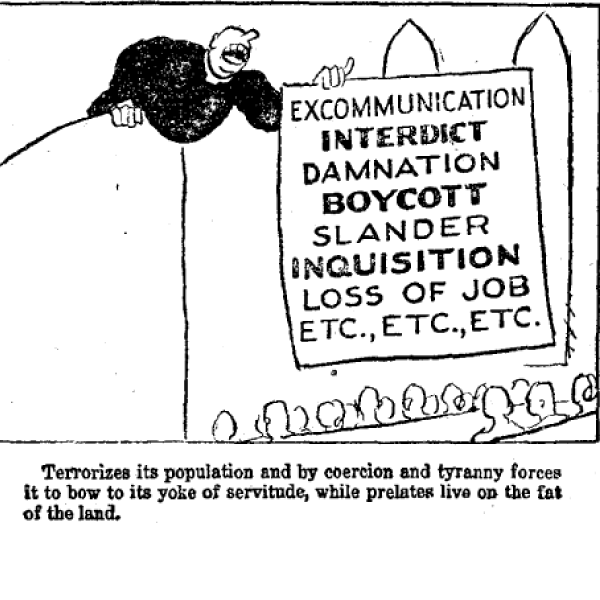
The Earliest negative evidence regarding apostasy was in 1937. It was for the history of religious dissent and excommunication. In fact, its usefulness is ironic: Watch Tower portrayed institutional excommunication as coercive in the 1930s, years before its own disfellowshipping system became substantially more formalized.
But the modern Watchtower obsession with former members and internal dissent became much more visible during the twentieth century.
After Charles Taze Russell died in 1916, the movement fractured. Groups broke away during the leadership struggles surrounding Joseph Rutherford, and Watchtower’s later history described some of these groups as apostates.
The modern turning point, however, came around 1980.
Watchtower’s own history says that by 1980, individuals who had served prominently within the organization began opposing its teachings.
The response was a flood of warnings. Articles appeared with titles such as:
By then, the apostate was no longer merely an ancient heretic. The apostate could be someone who had once worked at headquarters. Someone who had once believed. Someone who knew the system from the inside. That made them more dangerous – At least according to Watchtower.
The Apostate Thesaurus
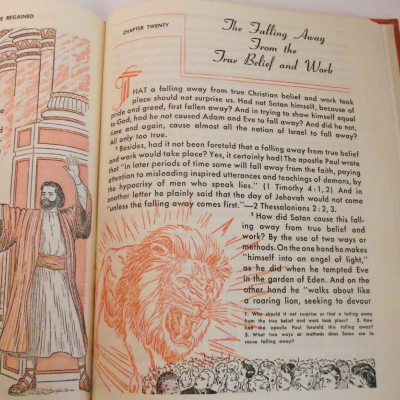
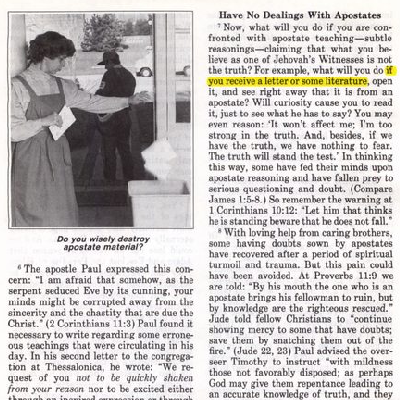
AvoidJW audited Watchtower’s own English-language library on their site. A search for “Apostate” returned over 946 results. “Apostates”: 427 Results. “Apostasy”: 853 Results. Over the years, Watchtower publications have used an impressive collection of labels and metaphors, with their site using 18 distinct labels for apostates.
Apostates and their ideas have been compared to:
It is remarkable how much effort has gone into describing people members are also told not to listen to. The formula is effective. If you label someone dangerous before the audience hears them, you do not have to rebut every argument they make. The label becomes the rebuttal.
But What Happens When Watchtower Changes Its Own Teachings?
This is where the definition becomes inconvenient. If apostasy means abandoning what was previously professed, then Watchtower has abandoned plenty. The organization simply uses different terminology when leadership does it.
Romans 13
For years, Bible Students taught that the “higher powers” of Romans 13 referred to Jehovah and Jesus. In 1962, the teaching changed. The “higher powers” were now understood to mean secular governments. A previously taught interpretation was abandoned. But that was not called apostasy. It was called an adjustment.
The Faithful and Discreet Slave
Watchtower previously taught that the “faithful and discreet slave” represented all anointed Christians collectively. In 2013, that changed.
The slave was redefined as a small group of anointed men closely identified with the Governing Body.
Again, a former teaching was abandoned. Again, not apostasy. Clarification.
Organ Transplants
In 1967, Watchtower compared organ transplants to cannibalism.
In 1980, organ transplantation became a matter of personal conscience. The earlier position disappeared.
But the person who disagreed before headquarters officially changed the teaching would not have been praised for getting ahead of the organization. That is the real problem. The issue is not simply doctrinal change.
Religious organizations change beliefs. The issue is who is allowed to change first.
The Blood Policy Just Changed Again
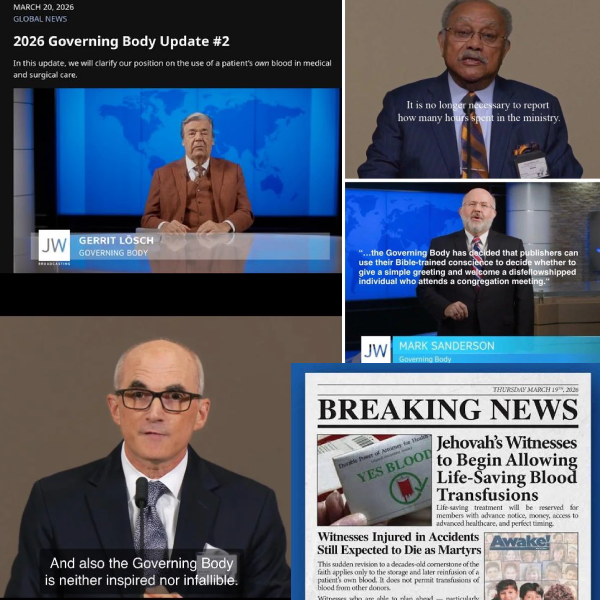
On September 18, 2026, the Governing Body announced another major adjustment to its blood policy.
For decades, Jehovah’s Witnesses were told that accepting the four primary components of blood, red cells, white cells, platelets and plasma, was prohibited.
Now, the organization says each Christian may decide for themselves whether to accept those components. The Governing Body explained that it does not want to: “go beyond the things that are written.” That is an extraordinary statement. Because the organization is now acknowledging that a position enforced for years went beyond what it currently believes Scripture actually requires. So what do we call that? A correction? An adjustment? New light? Certainly not apostasy. That word is apparently reserved for people without headquarters credentials.
“We Are Not Inspired”
The Governing Body has openly acknowledged that it is: “neither inspired nor infallible.” It admits that it can make mistakes in doctrine and organizational direction.
That honesty creates another question. If leadership itself acknowledges that it can be wrong, why is questioning its conclusions treated as spiritually dangerous? Why are members warned against examining contrary arguments? Why must correction always move from the top down?
A person who questions a doctrine today may be called rebellious. If the Governing Body changes the same doctrine tomorrow, the change becomes progressive understanding. That is an unusually convenient system.
But not only the above changes should be considered. The Organization heavily influences its followers to watch out for “Wordly influences” regarding how people dress, look, and act. Men were not allowed to have facial hair, and if so, they were treated much differently than the average Jehovah’s Witness. Women were not allowed to wear pants at religious functions. You couldn’t swear, watch R-rated movies, get involved in politics, salute the flag, celebrate holidays, have colored hair, tattoos, or body piercings. Or else you were treated like an outcast and, eventually, as poisonous to the rest of the Congregation because of your decisions. To them, this isn’t called apostasy, but it follows the same logic: like apostasy, it is influenced by the world.
So Who Is Really “Standing Away”?
Watchtower defines apostasy as abandonment, desertion, and standing away. Its own history contains repeated examples of the organization standing away from teachings it once promoted. That does not mean every doctrinal change is malicious. It means the label apostate is applied selectively.
When an individual abandons an established Watchtower interpretation, the organization may describe that person as spiritually dangerous. When Watchtower abandons the same kind of interpretation, the change becomes evidence of spiritual progress.
The action is similar. The branding is different.
Perhaps the most important question is not:
“Is this person an apostate?” It is: “Is what they are saying true?”
Labels cannot answer that. Evidence can. Old publications can. Archived videos can. Former teachings can. And archives have one inconvenient quality: They do not care what the current understanding is. They simply preserve what was said. Watchtower has spent decades warning members about people who “stand away.” But its own history shows that standing away from a former belief is not automatically condemned. Sometimes it is called apostasy. Sometimes it is called new light.
The difference appears to be who changed their mind first.
September 2026: The Apostate Warning Returns
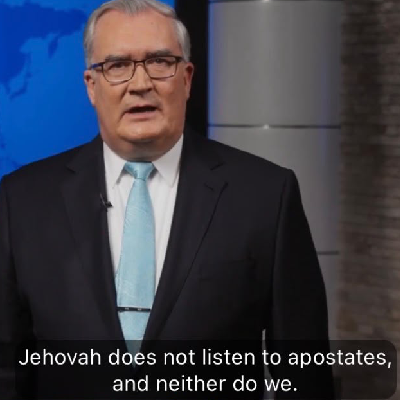

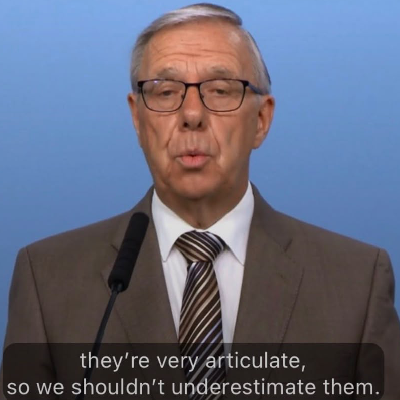
The September 2026 JW Broadcasting devoted a substantial portion of its program to misinformation, doubt, and, once again, apostates. Paul Gillies began his segment with the declaration: “We must reject the teachings of apostates,” describing their methods as displaying a “cunning spirit” and comparing them to smugglers who secretly introduce harmful ideas. The broadcast went on to characterize apostate material as innuendo, half-truths, lies, propaganda, and even something resembling contaminated food containing “traces of poison.”
The instructions were equally direct. Witnesses were told not to converse with apostates, read their literature, examine their websites, comment on their blogs, or even watch television programs featuring them “out of curiosity.” Gillies argued that if Jehovah does not grant an apostate an audience, “then why should we?” Kenneth Cook later summarized the point even more bluntly: “Jehovah does not listen to apostates, and neither do we.”
Perhaps the greatest irony is that earlier in the same broadcast, Witnesses are encouraged to “check the facts” and verify information before believing it. Yet when the subject turns to apostates, the recommended fact-checking process appears to stop at the door: do not read, do not watch, and do not engage. The September broadcast therefore offers a perfect snapshot of Watchtower’s long-running apostate paradox: carefully investigate misinformation unless it comes from someone the organization has already told you not to investigate. Other questions should be: Do you really know the Governing Body? Do they really speak for God? Should they really be telling YOU what to do?